ai regulation
California AI Kill Switch: What the Newsom Executive Order Means for Your Contracts
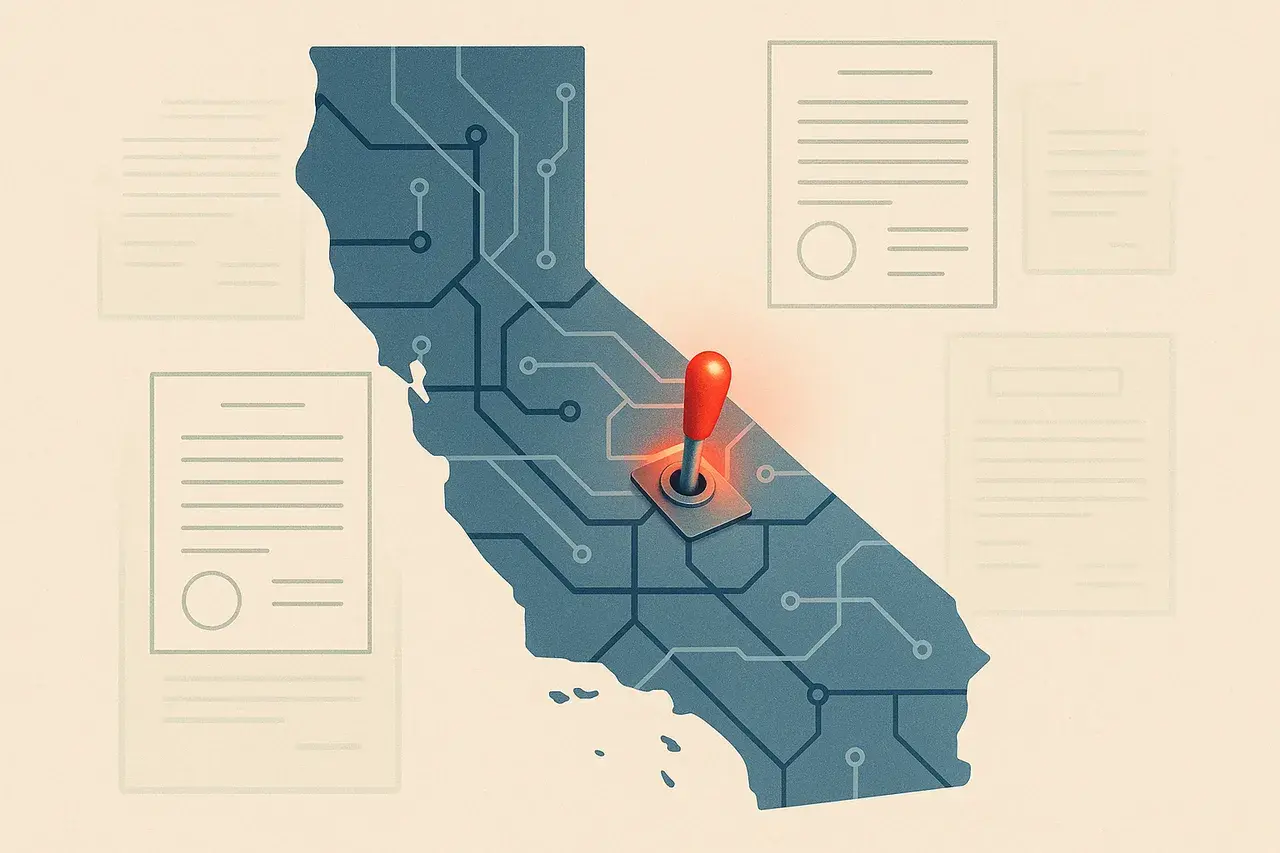
What the Newsom AI Executive Order Actually Requires
Governor Newsom has appointed a panel of expert advisers to implement his AI executive order, with one headline deliverable standing out above the rest: the development of a so-called "kill switch" mechanism that would allow authorities to shut down AI systems deemed to pose unacceptable risks. This is not speculative future legislation. It is an executive instruction already in force for California state agencies, and it signals the regulatory direction of travel for private-sector operators doing business in the state.
The practical meaning is this: AI systems deployed in California, particularly those touching critical infrastructure, public services or high-stakes decision-making, will need to demonstrate that a reliable shutdown or override capability exists. Vendors who cannot show this will face growing procurement barriers, and buyers who have signed AI contracts without addressing it will find those agreements increasingly non-compliant with emerging standards.
The Contractual Fallout: Where Existing Agreements Fall Short
Most AI vendor agreements signed before 2024 were drafted in a period when AI governance was largely voluntary. They addressed data privacy, intellectual property and service-level availability, but they did not anticipate regulatorily mandated shutdown capabilities, human override obligations or audit trails designed to satisfy a government safety panel.
The specific gaps in-house teams should audit now include the following. First, there is typically no clause requiring the vendor to maintain and disclose a technically verified kill switch or equivalent override mechanism. Second, termination-for-cause provisions rarely define regulatory non-compliance with a state executive order as a triggering event. Third, representations and warranties do not usually extend to the vendor's ongoing conformity with California AI safety standards. Each of these gaps creates liability exposure that did not exist twelve months ago.
Supply Chain and Procurement Implications
The kill switch requirement has supply chain consequences that extend well beyond tier-one AI vendors. If a company uses a software platform that itself relies on a third-party AI model, the contractual chain needs to carry the compliance obligation all the way down. This is a familiar problem from data protection law, where processor agreements must flow down controller obligations to sub-processors. The same logic will apply here.
Procurement teams issuing new requests for proposals for AI-enabled services in California should add a compliance schedule requiring vendors to confirm: the existence of a documented shutdown procedure, the identity of the personnel authorised to invoke it, and the maximum response time from instruction to cessation of AI-driven outputs. Without this, buyers risk inheriting the regulatory exposure their vendors have failed to address.
What In-House Teams Should Renegotiate Right Now
The immediate priority is to identify every live AI vendor agreement that touches California operations. That includes contracts for AI-assisted recruitment, content generation, fraud detection, customer service automation and any system influencing consequential decisions about individuals.
For each contract, in-house counsel should seek four amendments. First, a change-in-law clause that obliges the vendor to comply with new AI-specific state regulations and to notify the customer within a defined period, typically thirty days, of any material regulatory development affecting the service. Second, an audit right allowing the customer to verify that a kill switch or human override mechanism exists and functions. Third, a right to terminate without penalty if the vendor fails to achieve compliance within a reasonable cure period. Fourth, an indemnity covering any regulatory fine or third-party claim arising from the vendor's failure to meet California AI safety requirements.
Vendors, for their part, should be updating their standard terms proactively. Customers in California will begin asking these questions in every negotiation, and vendors who have already drafted compliant positions will close deals faster.
How AI Contract Management Tools Can Help
The volume of contracts requiring review following a regulatory shift of this kind is not manageable through manual processes alone. AI contract lifecycle management platforms can surface every agreement containing AI-related subject matter, flag the absence of required clauses, and draft jurisdiction-specific amendments in the company's own contracting style.
This is precisely the scenario in which AI-assisted contract review earns its keep: not in drafting a new agreement from scratch, but in triaging hundreds of existing contracts against a new compliance checklist and generating first drafts of the amendments needed. In-house teams that automate this triage will complete the exercise in days rather than months, and will do so with an audit trail that demonstrates due diligence to regulators.
What Comes Next: Watching the Legislative Pipeline
Newsom's executive order applies directly to California state agencies, but its influence on private-sector regulation will be significant. California has a consistent history of using public procurement standards to shape broader market norms, a pattern visible in its environmental requirements and data privacy framework. The experts appointed to implement this order will almost certainly recommend legislation that extends kill switch and human oversight requirements to private entities operating critical AI systems in the state.
In-house teams should treat the current moment as a preparation window, not a waiting period. The contract language required to comply with a future California AI safety statute will look very similar to the language needed to align with the executive order today. Teams that act now will not need to run an emergency amendment exercise when the legislation arrives.
Frequently asked questions
- What does California's AI kill switch requirement mean for vendor contracts?
- It means AI vendor agreements for California operations should now include clauses requiring vendors to maintain a documented shutdown or human override mechanism for their AI systems. Contracts that lack these provisions may leave buyers exposed to regulatory risk as California formalises its AI safety standards. In-house teams should seek amendments covering kill switch verification, audit rights and change-in-law obligations.
- Does the Newsom AI executive order apply to private companies?
- The executive order directly governs California state agencies, not private companies. However, it sets procurement standards that will affect any private vendor supplying AI services to the state, and it signals the direction of forthcoming legislation that is likely to extend requirements to the private sector. Companies doing business in California should treat it as an early compliance signal.
- Which contracts need to be reviewed following the California AI executive order?
- Any live agreement covering AI-enabled services used in California operations should be reviewed. This includes contracts for AI-assisted recruitment, fraud detection, customer service automation, content generation and any system that influences consequential decisions about individuals. Particular attention should be paid to whether the contract contains a change-in-law clause and any right to audit AI safety mechanisms.
- What is an AI kill switch and how should it be defined in a contract?
- An AI kill switch is a mechanism that allows authorised personnel to halt or override the outputs of an AI system quickly when it poses a risk. In a contract, it should be defined to include a documented shutdown procedure, named authorised personnel, a maximum response time and a requirement for periodic testing. Vendors should be required to certify compliance with this definition on a regular schedule.
- How can AI contract management software help with California AI compliance?
- AI contract lifecycle management platforms can scan existing agreements to identify those that lack required AI governance clauses, then generate jurisdiction-specific amendments aligned with the company's contracting style. This automates a triage process that would otherwise take legal teams months to complete manually, and produces an audit trail demonstrating proactive regulatory compliance.
See how Adira drafts in your voice and reads contracts from your side.
Explore the showroomWorking through a contract like this? Weave is Adira’s free tool to read, mark up, and connect any contract in your browser — no account needed.
Try Weave — freeRelated reading

California's AI Kill Switch Executive Order: Contract and Compliance Obligations In-House Teams Must Address Now
19 September 2026
California's AI Kill Switch Executive Order: What In-House Legal Teams Must Do Now
20 September 2026

Canada as EU Associate Member: What the CETA Upgrade Means for Global Contracts
18 September 2026