ai regulation
California's AI Kill Switch Executive Order: What In-House Legal Teams Must Do Now
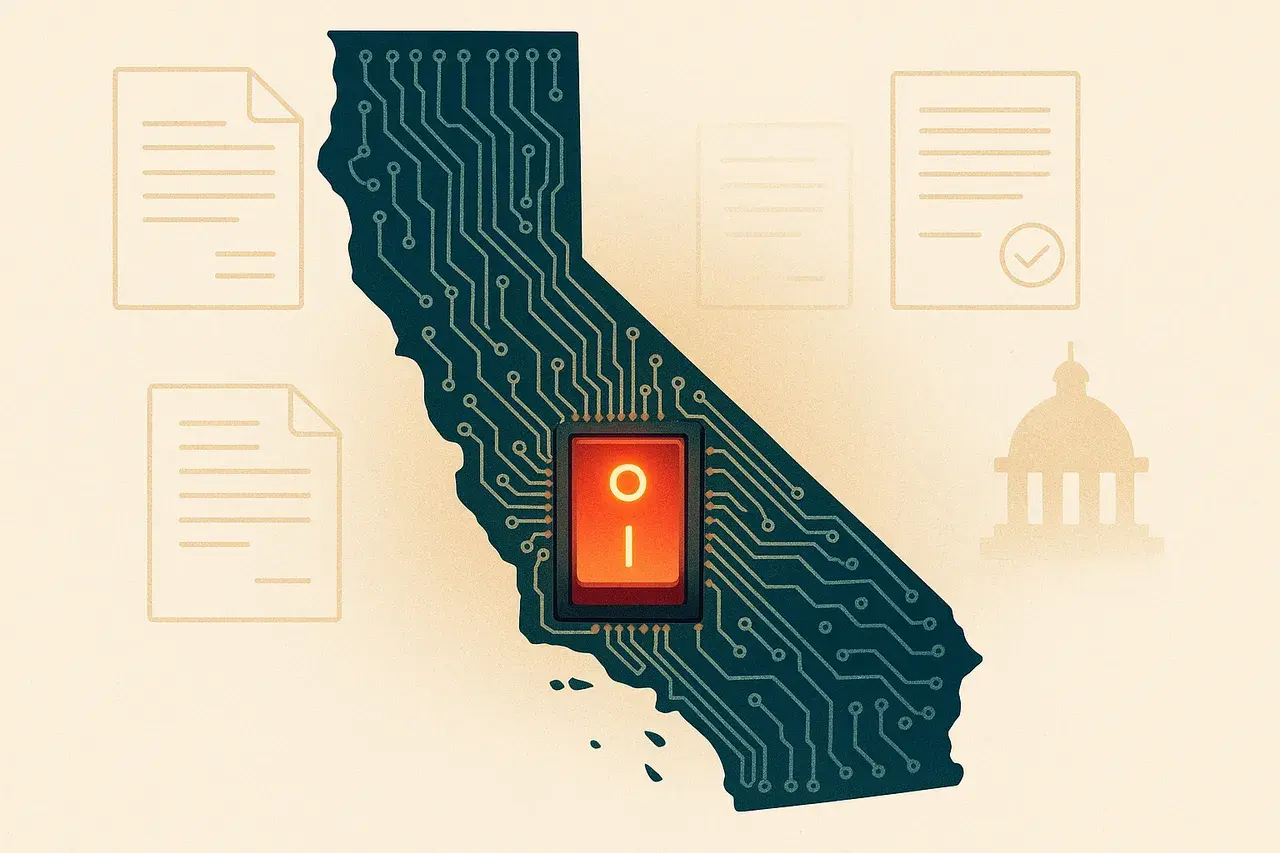
What the Newsom AI Kill Switch Executive Order Actually Requires
Governor Gavin Newsom's executive order directing California agencies to develop an AI kill switch mechanism, and to accelerate independent oversight of AI systems, is not a symbolic gesture. It is a regulatory signal that carries concrete downstream obligations for every company that deploys, procures, or integrates AI systems within California's jurisdiction. The order instructs state agencies to establish the technical and procedural capacity to shut down AI systems that pose unacceptable risks. Independent oversight bodies are to be stood up with real investigative authority. For commercial entities operating alongside or on behalf of the state, and for those simply subject to California law, the contractual implications are immediate.
The order does not, by itself, amend a statute. But executive orders of this nature routinely precede procurement rules, licensing conditions, and sector-specific guidance that do carry legal force. In-house teams that wait for implementing legislation before acting will find themselves renegotiating contracts under time pressure rather than from a position of strength.
How AI Oversight Regulation Reshapes Vendor and Procurement Contracts
The most direct contractual fallout falls in three areas: AI vendor agreements, technology procurement contracts, and supply-chain terms where AI-enabled decision-making sits upstream of a company's own obligations.
First, any agreement that governs the use of an AI system for consequential decisions, including hiring, credit, content moderation, or public-facing services, now needs an explicit shutdown and suspension clause. This clause must specify who holds the authority to invoke a shutdown, the notice period, liability allocation during a suspension period, and the data-handling obligations that apply when a system is taken offline. Many existing AI vendor agreements are silent on all four of these points.
Second, indemnity provisions require revisiting. If a California oversight body orders cessation of an AI system that a vendor is running on your behalf, and your contract places operational liability with the vendor, you need to confirm that indemnity survives a regulator-ordered shutdown and covers any third-party claims arising from the interruption. Many standard vendor indemnities carve out regulatory actions.
Third, and most overlooked, are supply-chain contracts where AI sits further up the chain. If your contract manufacturer or logistics provider uses AI-driven scheduling or quality-control systems that California may later scrutinise, your own delivery and service-level commitments could be disrupted by an order that is not even directed at you.
Compliance Obligations That Arise Before the Legislation Lands
California's AI regulatory trajectory is now well established. The executive order follows a series of AI-related bills, including those requiring disclosure of AI use in consumer interactions and restrictions on AI in employment decisions. The kill switch order accelerates the formation of an oversight body that will almost certainly require regulated entities to register covered AI systems, maintain audit logs, and demonstrate the technical capacity to suspend those systems on demand.
In-house legal and compliance teams should treat this as the equivalent of a pre-rulemaking notice. That means beginning an AI systems inventory now, mapping which systems are deployed in California or affect California residents, and assessing which contracts governing those systems lack the operational controls that an oversight body is likely to mandate. Companies that have already carried out this mapping in response to the EU AI Act will have a significant head start, though the California framework will have its own jurisdictional specifics.
What to Renegotiate and What to Watch in AI Vendor Agreements
The priority renegotiation list for most in-house teams should include the following. Termination for regulatory cause: most AI vendor contracts allow termination for breach or convenience, but not specifically for a regulatory shutdown order. Add a clause that treats a government-directed suspension as a force majeure or regulatory event, with defined consequences for each party. Audit and inspection rights: an oversight body may require access to model documentation, training data summaries, or system logs. Ensure your vendor agreement obligates the vendor to cooperate with such requests and to indemnify you for the cost of compliance where the obligation arises from the vendor's system. Data continuity on shutdown: if an AI system is suspended, what happens to the data it holds or processes? This needs a defined protocol, not silence.
Watch clauses that impose penalties for system downtime. If downtime is caused by a regulatory order rather than vendor failure, a well-drafted agreement should not expose either party to service-level penalties. Many agreements do not make this distinction.
The Broader Signal for AI Contract Governance
Newsom's order is part of a broader pattern in which AI governance is shifting from voluntary frameworks to enforceable regulatory regimes with real operational teeth. The EU AI Act, the UK's sector-by-sector AI guidance, and now California's kill switch architecture all point in the same direction: AI systems must be auditable, suspendable, and accountable, and the contracts that govern those systems must reflect those requirements.
For companies using AI contract lifecycle management tools, including platforms like Adira that read agreements from your side of the table and flag jurisdiction-specific risk, the question is whether your current AI vendor agreements would survive a California regulatory audit today. In most cases, the honest answer is no. The time to address that is before the oversight body issues its first enforcement notice, not after.
Frequently asked questions
- What does California's AI kill switch executive order mean for businesses?
- It signals that California will require companies deploying AI systems to have the technical and contractual capacity to suspend those systems on regulatory demand. Businesses should immediately review AI vendor agreements for shutdown clauses, indemnity provisions, and audit rights. Waiting for implementing legislation before acting is a significant compliance risk.
- Does the Newsom AI executive order create legal obligations for private companies right now?
- The order itself is directed at California state agencies, but it establishes oversight infrastructure that will affect private companies through procurement rules, licensing conditions, and sector-specific guidance. Companies contracting with the state or deploying AI affecting California residents should treat this as an immediate compliance trigger.
- What contract clauses should in-house legal teams add because of California AI regulation?
- The priority clauses are: a regulatory shutdown or suspension provision that allocates liability during a government-ordered cessation; an audit and inspection cooperation obligation on the vendor; a data continuity protocol for when a system goes offline; and a carve-out from service-level penalties where downtime results from a regulatory order rather than vendor failure.
- How does the California AI kill switch order compare to the EU AI Act?
- Both frameworks require AI systems to be auditable and suspendable, but they differ in scope and mechanism. The EU AI Act is a comprehensive statutory regime with risk tiers; California's approach is currently executive-order-driven and focused on oversight infrastructure and shutdown capacity. Companies compliant with the EU AI Act have a useful foundation but will need to address California-specific requirements as they emerge.
- Which types of AI systems are most likely to be affected by California's oversight order?
- Systems used for consequential decisions affecting California residents are the primary target: hiring and HR tools, credit and financial decisions, content moderation at scale, healthcare triage, and public-facing government services. AI embedded in supply-chain or logistics operations that indirectly affects Californians may also fall within scope as the oversight framework develops.
See how Adira drafts in your voice and reads contracts from your side.
Explore the showroomWorking through a contract like this? Weave is Adira’s free tool to read, mark up, and connect any contract in your browser — no account needed.
Try Weave — freeRelated reading

California's AI Kill Switch Executive Order: Contract and Compliance Obligations In-House Teams Must Address Now
19 September 2026
When Misconduct Meets Process: What the Fieldfisher EAT Decision Tells HR and Legal Teams
5 August 2026
Chesapeake Bay Executive Order Repeal: Environmental Compliance Contracts and Supply-Chain Fallout for In-House Teams
18 September 2026