legal ethics
When Neutrality Becomes a Position: What Lawyers Can Learn from the Verfassungsblog Debate
The Erfurt Moment and Its Wider Resonance
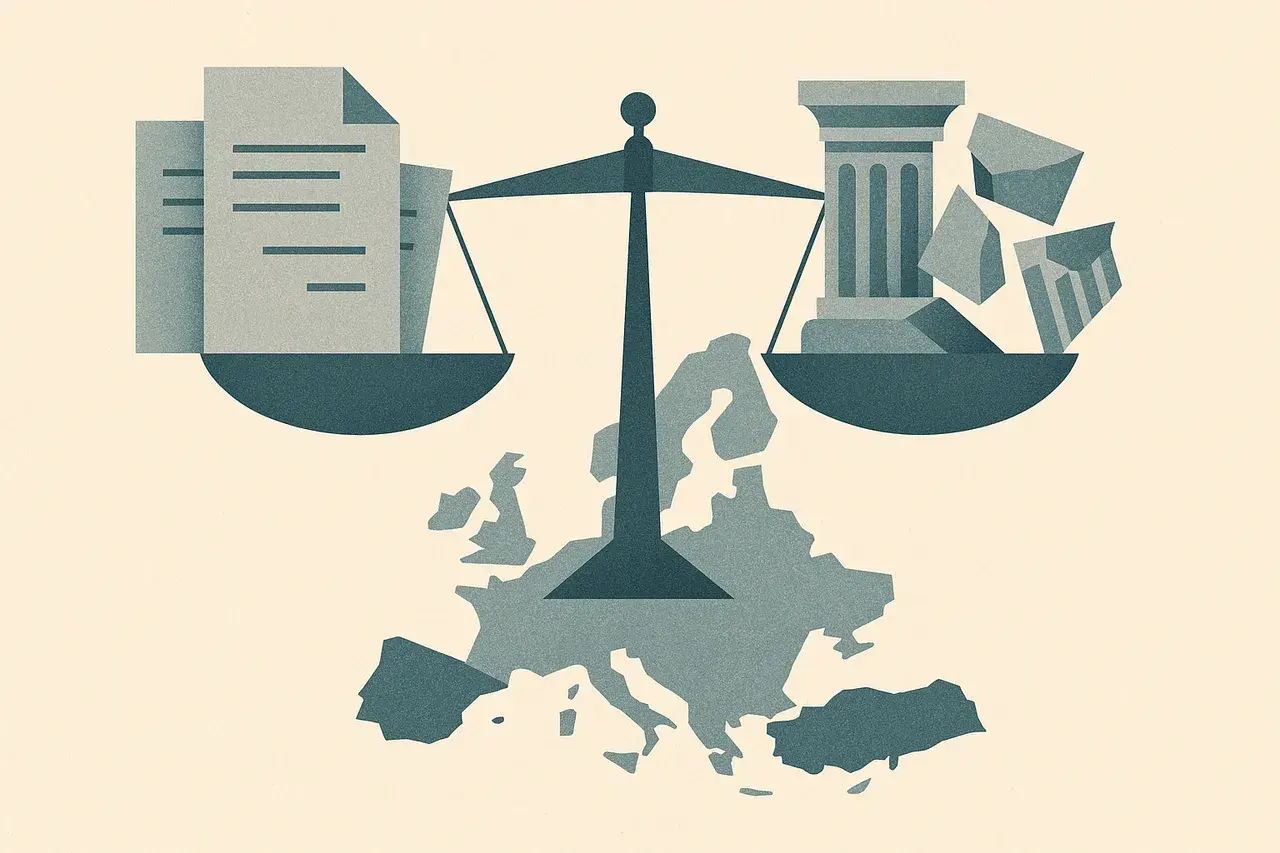
The managing director of Verfassungsblog, one of Europe's most respected legal-scholarly platforms, recently wrote candidly about joining protests against the AfD convention in Erfurt, asking openly whether a commitment to neutral legal discourse required him to treat parties hostile to constitutional order the same as parties loyal to it. His conclusion, broadly stated, was that false equivalence is itself a choice, and not a neutral one.
That argument deserves serious attention beyond the German political context. For lawyers, compliance officers and in-house counsel across Europe, the question of institutional neutrality sits at the heart of daily professional life. It is also, increasingly, a live issue for the legal technology tools those professionals rely upon.
The False Comfort of Procedural Neutrality
Legal training encourages a particular kind of discipline: apply the rules consistently, advise on what the law says rather than what you wish it said, and leave value judgements to clients and courts. That discipline is genuinely valuable. It protects clients from advocate capture and keeps legal advice honest.
But procedural neutrality has limits. A contract review tool that flags every clause with equal indifference, treating a clause that waives liability for fraudulent misrepresentation the same as one that adjusts payment terms, is not neutral. It is unhelpful. Lawyers themselves make constant judgement calls about what matters, and the frameworks they use to make those calls are never purely technical. They are shaped by legal systems, professional ethics rules and, ultimately, by a conception of what law is for.
The Verfassungsblog episode makes this visible in a dramatic way, but the underlying tension is present every time a legal team decides which risks to escalate, which contractual positions to hold, and which counterparty behaviours to flag as genuinely problematic rather than merely suboptimal.
What This Means for In-House Teams Under European Law
In-house lawyers operating under EU law already navigate a landscape that is explicitly value-laden. The EU Charter of Fundamental Rights, the rule-of-law conditionality mechanisms built into recent EU budget frameworks, and the growing body of ESG-linked disclosure obligations all reflect a legal order that does not pretend to be indifferent to outcomes. Compliance with EU law is not just procedural. It asks companies to engage with substantive commitments around human dignity, fair competition and democratic governance.
For in-house counsel, this creates a practical challenge. When a counterparty's jurisdiction raises genuine rule-of-law concerns, or when a supplier's governance structure conflicts with a company's own compliance obligations, the question is not simply whether the contract is technically enforceable. It is whether entering into it is consistent with the legal and ethical framework the in-house team is there to uphold.
That is not a political question. It is a legal one, and it is one that requires lawyers to make considered judgements rather than retreat into procedural neutrality.
How AI Contract Tools Should Handle Value-Laden Legal Contexts
This is where the implications for legal AI become concrete. A contract intelligence platform that reads agreements purely as collections of clauses, without reference to the jurisdiction, the counterparty context or the legal values embedded in the governing law, will give advice that is technically accurate but practically incomplete.
Adira is built on the premise that reading a contract from your side means understanding your legal environment, not just parsing text. When Adira drafts or reviews an agreement governed by German, French or EU law, it brings to that task an understanding of the legal norms that shape what a reasonable, well-advised party in that jurisdiction would accept. That includes awareness of mandatory rules, public policy limits and the kind of contextual legal judgement that distinguishes good legal advice from a keyword search.
The Verfassungsblog debate is, at one level, about politics. But at another level it is about whether legal institutions, human or technological, are permitted to recognise the difference between a party that operates within a constitutional order and one that does not. For AI tools operating in legal contexts, the analogous question is whether they can distinguish between a contractual position that is aggressive but legitimate and one that is structurally incompatible with the legal order they are supposed to serve.
The Practical Takeaway for Law Firms and Legal Departments
Lawyers should resist the temptation to treat neutrality as a safe default. Choosing not to make a judgement is still a choice, and in a legal environment shaped by explicit values, it can be the wrong one.
For legal technology, the lesson is similar. Tools that help lawyers do their jobs better need to understand not just what a contract says, but what it means in context, including the legal, jurisdictional and ethical context in which it will be performed. That is a harder problem than clause extraction. It is also the only problem worth solving.
Sources
See how Adira drafts in your voice and reads contracts from your side.
Explore the showroom