data governance
When AI Systems Know Too Much: Lessons for Contract Intelligence from Fiction's Nearest Neighbour
Fiction as a Rehearsal for Real Risk
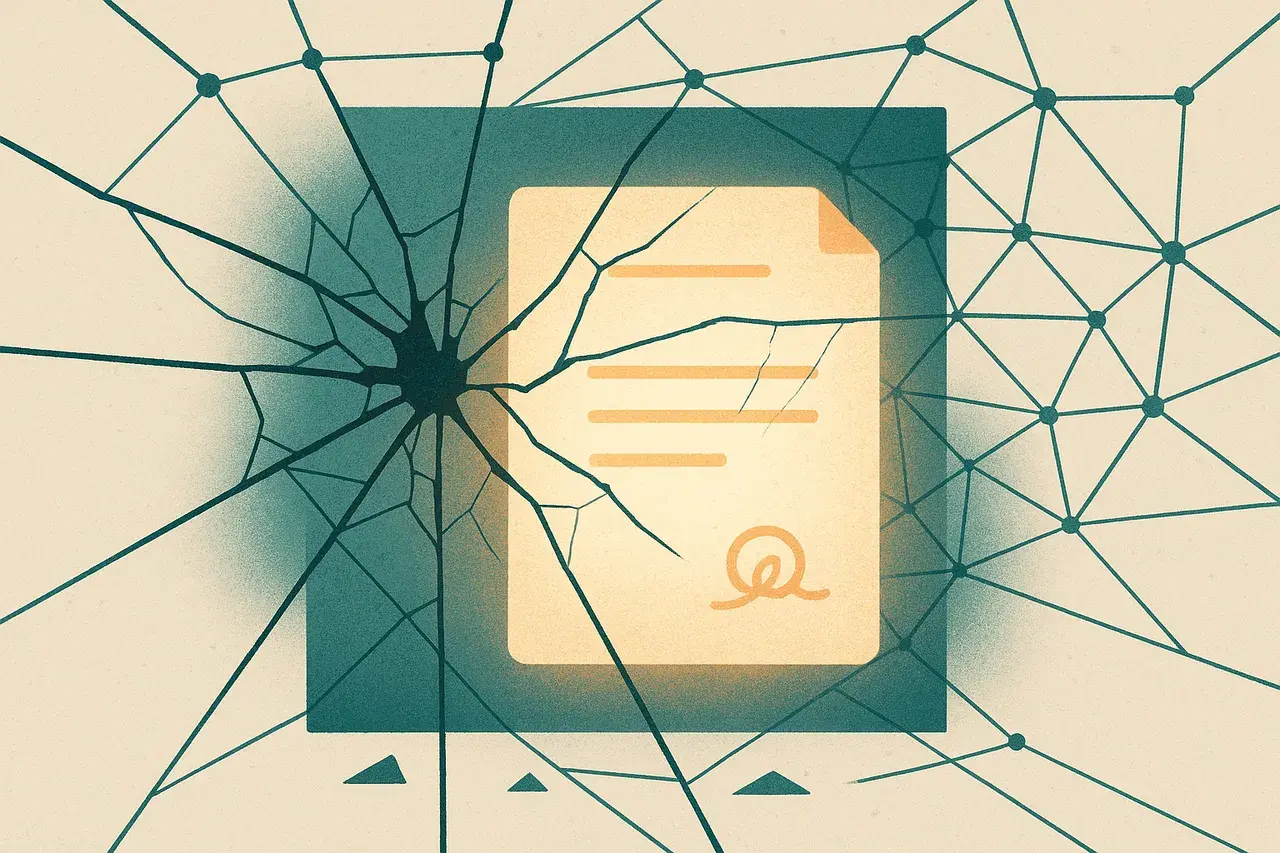
Summer fiction has always served legal professionals as a low-stakes rehearsal space. When a story centres on a data leak inside an AI-powered legal operation, it is not escapism. It is scenario planning with better prose. The serialised thriller circulating in legal-AI circles this month imagines exactly the kind of insider breach that in-house general counsels quietly list near the top of their risk registers, even if it rarely appears in the board deck.
The premise is pointed: an organisation's AI system becomes the vector through which confidential commercial intelligence escapes. The drama is human, but the mechanism is technological. That combination is precisely where legal teams need to focus their thinking right now.
The Confidentiality Paradox at the Heart of CLM
Contract lifecycle management tools are built on a foundational promise: aggregate your agreements, extract the intelligence buried inside them, and let the organisation make better decisions faster. That promise is real and the productivity gains are measurable. But aggregation creates concentration. When every non-disclosure agreement, every supplier contract, every licensing term and every earn-out schedule lives in one intelligent system, the value of that repository to an adversary is correspondingly high.
This is what might be called the confidentiality paradox of modern CLM. The more useful the system, the more sensitive the data it holds, and therefore the more consequential any failure of access control or data governance becomes. A filing cabinet full of signed PDFs is a nuisance to breach. A well-trained contract intelligence platform that understands commercial relationships, pricing architecture and counterparty exposure is a genuinely attractive target.
Fiction writers understand this intuitively. Risk managers should too.
What 'Reading from Your Side' Actually Requires
Adira is built on a principle that turns out to have significant security implications: the system reads contracts from the client's side. That means the analytical frame, the risk flags, the playbook deviations and the negotiation history are all oriented around one party's interests and one party's data. There is no pooled model trained on a anonymised blend of thousands of organisations' most sensitive commercial terms.
That design choice matters enormously when you consider the fictional leak scenario. If an AI system is drawing on shared training data or retaining user inputs to improve a centralised model, then the boundary between one client's proprietary intelligence and another's becomes porous in ways that are difficult to audit and nearly impossible to explain to a court. A system that works only with the data you give it, governed by permissions you control, is not just a privacy preference. It is a defensible architecture.
In-house teams evaluating CLM platforms should ask vendors a direct question: does the system learn from my contracts in a way that could benefit a competitor who uses the same platform? The answer shapes your entire data governance posture.
Jurisdiction, Liability and the Leak That Travels
The fictional thriller gestures at something else that deserves serious attention: when AI-assisted legal work crosses borders, the liability framework for a data breach becomes genuinely complicated. A contract drafted under English law, reviewed by an AI trained on US case law, stored on servers in the European Union and accessed by counsel in Singapore does not sit neatly inside any single regulatory regime.
Adira's approach of knowing the law of the jurisdiction it works in is partly a quality control measure, ensuring that the advice it surfaces reflects applicable local standards rather than a generic common-law blend. But it is also a data governance measure. When the analytical layer is jurisdiction-aware, the system can flag when particular data handling obligations apply, when a governing law clause has cross-border privacy implications, and when a proposed clause might be unenforceable in the seat of arbitration the parties have chosen.
That kind of jurisdictional intelligence does not eliminate the risk that fiction dramatises. It does, however, mean that the system participates actively in identifying the risk rather than silently compounding it.
Practical Steps for In-House Teams Reading Between the Lines
The most useful response to a good legal-AI thriller is not anxiety. It is a checklist. In-house teams should use the summer quiet period to ask three questions of every AI tool in their current stack.
First, where does our data reside, who can access it, and under what contractual terms does the vendor handle it? Second, what is the model training architecture: are our contracts being used to improve a shared system, and if so, can we opt out? Third, does the system have meaningful role-based access controls, so that a junior procurement analyst cannot inadvertently query information about a sensitive M&A target?
None of these questions require a background in machine learning. They require the same commercial scepticism that good lawyers apply to every other vendor relationship. The fact that the vendor sells AI does not suspend the ordinary rules of due diligence. If anything, the sophistication of the product demands more rigorous scrutiny, not less.
Good fiction earns its place in the professional reading list when it makes the abstract concrete. A leak inside a legal AI system is not a fantastical premise. It is a plausible Tuesday morning. The teams that have already asked the hard questions will handle that Tuesday considerably better than those who assumed the technology was its own safeguard.
See how Adira drafts in your voice and reads contracts from your side.
Explore the showroomWorking through a contract like this? Weave is Adira’s free tool to read, mark up, and connect any contract in your browser — no account needed.
Try Weave — free