global legal
Redistricting and the Rule of Law: What Emergency Injunction Denials Mean for Electoral Compliance Globally
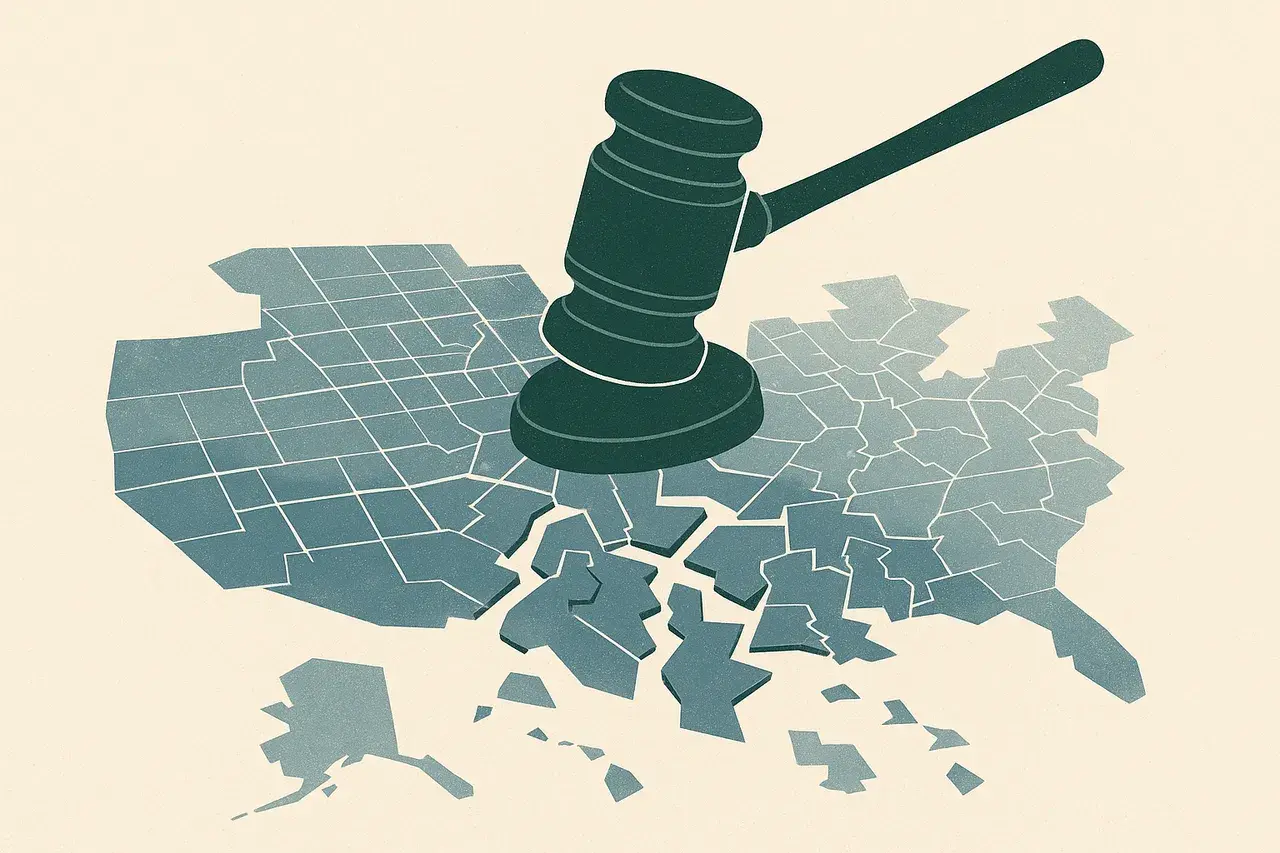
Why a Single Justice's Order on Redistricting Matters Beyond Missouri
On its face, Justice Kavanaugh's decision to deny Missouri's emergency application in Hoskins v. von Glahn looks like a narrow, procedural moment in American domestic politics. In practice, it illustrates a principle that general counsel and law firms advising public-sector clients anywhere in the world must understand: courts will routinely refuse to allow new electoral boundaries to operate until the proper legal preconditions, whether a referendum, a legislative supermajority, or an independent commission's sign-off, have been satisfied. That refusal has immediate compliance consequences for everyone from returning officers to the technology vendors whose contracts depend on a fixed, legally valid electoral geography.
The Missouri Supreme Court had already barred the redrawn congressional map from taking effect before voters weighed in. The US Supreme Court's single-justice order simply preserved that status quo. Yet the episode crystallises a recurring global pattern: legislatures or executives attempt last-minute redistricting, a court intervenes, and a cascade of downstream obligations must be unwound or suspended.
The Rule and Who It Binds
In the Missouri context, the binding rule is that the state constitution requires voter approval before newly drawn congressional districts can apply. That is not unusual by international standards. Many democracies impose procedural locks on boundary changes: Australia requires recommendations from independent electoral commissions with fixed notice periods; Canada mandates parliamentary tabling and a 30-day objection window; the United Kingdom operates under the Parliamentary Constituencies Act 2020, which requires the Boundary Commissions to run multi-year public consultation cycles.
Who is bound when a court freezes a map? The answer is broader than it first appears. State and local election authorities must revert to the existing map, reprinting ballots and reconfiguring voter rolls. Political parties and candidates who filed under the new districts face uncertain standing. Critically, election-technology vendors, data suppliers, and communications agencies operating under contracts keyed to specific district identifiers must pause or renegotiate work in progress. Any contract that uses electoral district codes as a primary data field is, at least temporarily, working from an invalidated reference point.
Effective Dates and the Problem of Compressed Timelines
The practical danger that courts and contracting parties consistently underestimate is timing compression. When an emergency redistricting challenge reaches the apex court weeks before an election, the window for remediation is extremely narrow. Justice Kavanaugh issued his order without referring the matter to the full court, which signals that single-justice emergency relief is a well-worn procedural tool in the United States. Equivalent mechanisms exist in other systems: a UK High Court judge can grant an injunction on short notice; the European Court of Human Rights can apply interim measures under Rule 39; the Inter-American Commission can grant precautionary measures affecting electoral processes.
In every case, the effective date question becomes urgent. Contracts that assume a specific electoral map becomes operative on a fixed date need contingency clauses. Public-sector procurement frameworks rarely include force-majeure language broad enough to cover a judicial stay of a boundary change. That gap is where legal exposure accumulates.
Contract Changes Forced by Electoral Map Litigation
General counsel advising election authorities, political parties, or commercial vendors in any jurisdiction should audit their contracts for three specific risks when redistricting litigation is live.
First, scope-of-work definitions keyed to named districts or numeric identifiers need a change-control mechanism triggered by a court order, not merely by a government decision. Second, data-processing agreements that reference electoral geography as a lawful basis or a data-field standard need to specify which version of the official boundary dataset is authoritative, and who bears the cost of reverting to a prior version. Third, indemnity clauses must allocate the risk of wasted expenditure when a vendor has already configured systems for districts that a court subsequently freezes.
Beyond the immediate transaction, the Missouri episode is a reminder that regulatory-compliance programmes in political consultancy, civic technology, and public administration need to treat a judicial stay of a redistricting map as a named risk event, with a documented response plan, rather than an afterthought.
Lessons in Democratic Legitimacy for a Global Audience
The underlying principle the Missouri Supreme Court enforced, and the US Supreme Court preserved, is that electoral rules derive legitimacy from prior public consent, not from a legislature's unilateral act shortly before polling day. That principle resonates in jurisdictions as different as South Africa, where the Constitutional Court has intervened in electoral-roll disputes, and Germany, where the Federal Constitutional Court scrutinises the proportionality of constituency boundary formulae.
For GCs and law firms advising clients who operate across multiple democracies, the practical upshot is straightforward. Redistricting is not a self-contained political event. It is a regulatory change with a compliance tail: contracts must be reviewed, data standards must be updated, and contingency plans must exist for the scenario, now well-evidenced, where a court freezes the change before it takes effect. Building that review into your electoral-cycle legal calendar is no longer optional.
Frequently asked questions
- What does it mean when the Supreme Court denies an emergency application to use a redrawn congressional map?
- It means the court is leaving in place the lower court's ruling, so the new district boundaries cannot be used in the upcoming election. The existing map remains operative until the legal precondition, in Missouri's case a voter referendum, is satisfied. Election authorities and vendors must continue working from the prior boundary configuration.
- Can a state redraw its congressional districts mid-election cycle?
- Technically yes, but most state constitutions and federal courts impose procedural requirements before a new map takes legal effect. Courts will issue injunctions preserving the status quo if those requirements have not been met. Missouri's constitution specifically requires voter approval, which is why the redrawn map was blocked.
- How does a redistricting court order affect vendor contracts and election-technology providers?
- Any contract that uses electoral district identifiers as a core data field must revert to the previously valid boundary dataset when a court freezes a new map. Vendors who have already built systems around the new districts face potential wasted-expenditure claims if contracts lack clear change-control and contingency clauses.
- What is a single-justice order at the US Supreme Court and how is it different from a full court ruling?
- A single-justice order is issued by one of the nine justices acting in their capacity as Circuit Justice, typically to grant or deny emergency relief quickly without convening the full court. It is binding but can be referred to the full court if the justice chooses. Justice Kavanaugh declined to refer the Missouri redistricting application, making his denial final on the emergency question.
- Do other countries have similar court powers to block last-minute electoral boundary changes?
- Yes. Courts in the UK, Canada, Australia, Germany, and South Africa all have mechanisms to freeze electoral boundary changes that have not followed the legally required process. The specific trigger varies, ranging from independent commission procedures to parliamentary notice periods, but the principle that courts protect procedural legitimacy in elections is widely shared.
See how Adira drafts in your voice and reads contracts from your side.
Explore the showroomWorking through a contract like this? Weave is Adira’s free tool to read, mark up, and connect any contract in your browser — no account needed.
Try Weave — free