us politics
When Political Rhetoric Reshapes Maps: Contract and Compliance Risks for Businesses Operating in US States
Why a Mislabelled Map Is a Legal Risk Signal
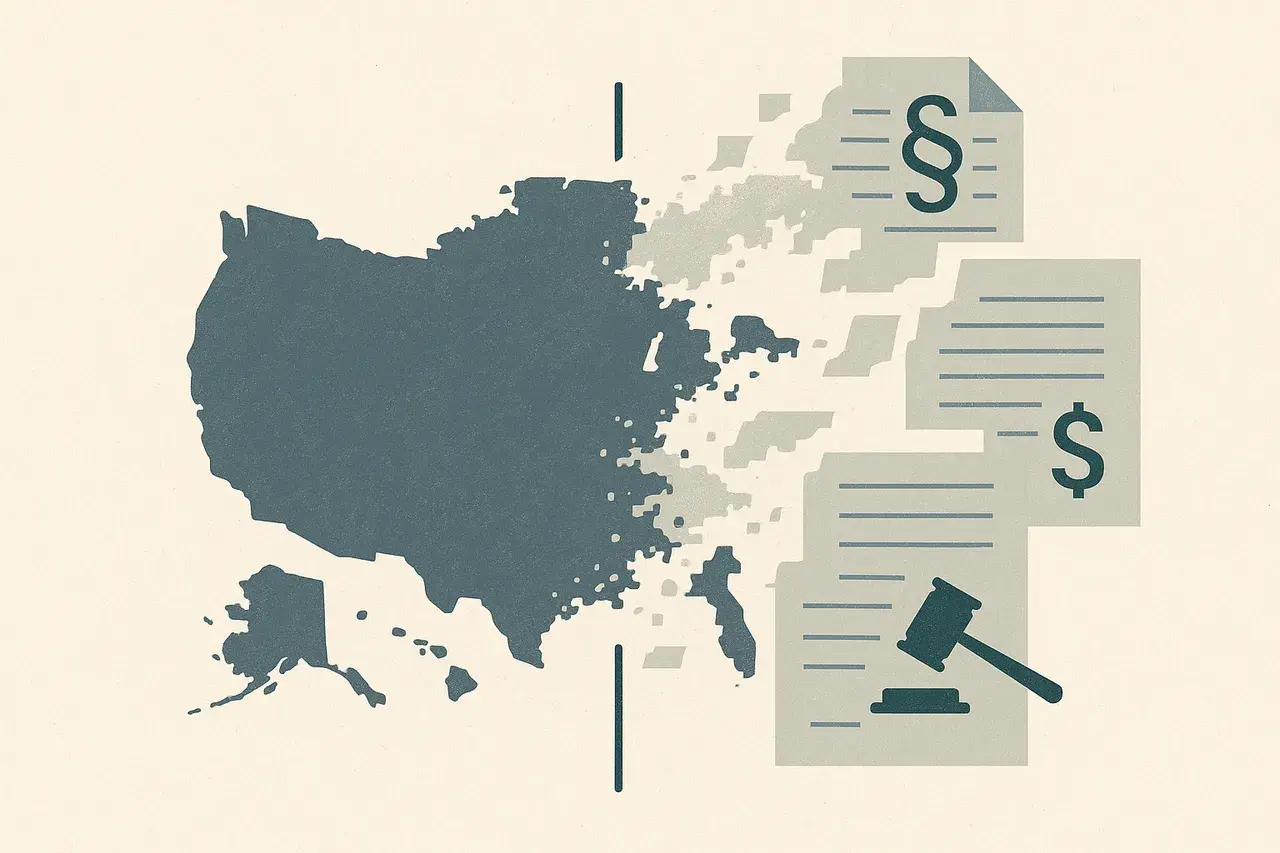
When President Trump shared a map online labelling New Mexico as 'New America', it originated from an internet hoax rather than any policy document. No statute changed overnight. No boundary shifted. Yet the episode illustrates something that contract and compliance professionals should take seriously: the gap between official legal reality and the political rhetoric circulating at the highest levels of government is narrowing, and that gap creates operational risk for any business whose contracts are anchored to US state jurisdiction.
In-house counsel who dismiss such moments as mere social media noise may be underestimating how quickly rhetoric can translate into executive orders, funding freezes, federal preemption manoeuvres, or pressure on state-level regulatory bodies. The legal and contractual fallout rarely announces itself in advance.
Jurisdictional Clarity in Contracts: Why Governing Law Clauses Are Under Pressure
Every commercial contract that touches the United States specifies a governing law. For businesses operating in New Mexico or any other state where federal-state tensions run high, that clause is no longer administrative boilerplate. It is a live risk variable.
When federal policy signals conflict with state legal frameworks, courts face questions about preemption, and contracting parties face questions about which set of rules actually governs their obligations. Procurement contracts with state agencies, for example, may contain provisions that assume a stable regulatory environment. If federal funding to a state is redirected or conditioned on behavioural compliance, counterparty credit risk increases and performance timelines become unreliable.
In-house teams should audit governing law clauses across their portfolio, paying particular attention to contracts with state government entities, federally funded programmes, and cross-border supply arrangements that route through politically contested jurisdictions.
Force Majeure and Political Risk: Filling the Drafting Gap
Most standard force majeure clauses were written to address natural disasters, wars, and labour strikes. Very few explicitly cover the category that lawyers increasingly call 'political risk': regulatory reversals, executive action that contradicts state law, or administrative disruption caused by federal-state conflict.
The Trump administration's track record since 2025 includes rapid executive orders affecting trade, immigration, and federal spending, all of which cascade into contract performance. A supplier whose workforce relies on a specific visa category, or a logistics partner whose route crosses a jurisdiction subject to sudden federal scrutiny, may find that their obligations are technically intact but practically undeliverable.
Drafting better force majeure language means specifying regulatory change, federal preemption events, and named executive action categories as qualifying triggers. It also means building in a shorter notice window and a structured renegotiation pathway rather than a blunt termination right.
Supply Chain Contracts and the State-Level Compliance Patchwork
New Mexico is not an arbitrary example in the current political climate. The state is home to significant federal defence and energy assets, a large proportion of federally managed land, and a growing technology corridor. Businesses with supply chain exposure there, or in similarly positioned states such as Arizona and Colorado, should map their contractual dependencies against the specific regulatory licences, permits, and funding flows that underpin supplier performance.
When federal policy signals suggest a reordering of geographic or administrative priorities, procurement teams need to know which supplier relationships carry embedded state-law compliance obligations that could be disrupted. Representations and warranties relating to regulatory compliance should be reviewed for currency. Any clause that assumes a stable licensing environment deserves a closer look.
Adira's contract reading capability allows legal and procurement teams to surface all references to specific jurisdictions, regulatory bodies, and compliance certifications across a contract portfolio in minutes rather than weeks, which matters considerably when the political environment moves faster than a manual review cycle.
What In-House Teams Should Renegotiate or Watch Right Now
The practical checklist for in-house counsel navigating this environment has several layers. First, identify all contracts where performance depends on a specific state regulatory status, federal grant, or jurisdictional determination. Second, review change-in-law provisions to confirm they cover regulatory interpretation shifts, not just enacted legislation. Third, assess whether material adverse change definitions are broad enough to capture federal administrative action that impairs a counterparty's ability to perform.
Beyond renegotiation, monitoring obligations matter equally. Legal teams should establish a watching brief on any federal executive action that touches their key jurisdictions, and they should have a documented escalation process that connects that intelligence to the contract management function before a breach or dispute arises.
Political noise at the level of a misattributed map may seem far removed from a supplier contract or a services agreement. The lesson of the current political era, however, is that the distance between rhetoric and regulatory consequence has compressed considerably. Contracts written for a stable environment need to be re-read for a volatile one.
Frequently asked questions
- How does political uncertainty affect governing law clauses in US contracts?
- When federal and state regulatory priorities conflict, governing law clauses become live risk variables rather than administrative formalities. Courts may face preemption questions, and the practical legal framework governing a contract can shift without any change to the contract text itself. In-house teams should audit governing law and change-in-law provisions regularly during periods of political volatility.
- What is political risk in a contract context and how should it be addressed?
- Political risk in contracts refers to events such as executive orders, regulatory reversals, or federal-state conflicts that impair a party's ability to perform its obligations. Standard force majeure clauses rarely cover these scenarios explicitly. Businesses should draft force majeure and material adverse change provisions to include named categories of political and regulatory disruption, along with structured renegotiation rights.
- What should in-house legal teams do when US federal policy conflicts with state law?
- In-house teams should first identify which contracts depend on state-level regulatory licences, funding, or compliance frameworks that could be affected by federal action. They should then review change-in-law and force majeure provisions for adequacy, update supplier representations and warranties, and establish a monitoring process that feeds political and regulatory intelligence directly into contract management workflows.
- Can a US state's regulatory environment change fast enough to affect existing contracts?
- Yes. Federal executive orders, funding conditions, and preemption actions can alter the practical regulatory environment for businesses in a specific state within days. Existing contracts that assume a stable licensing or compliance backdrop may become difficult or impossible to perform without any formal change in state statute. Change-in-law provisions and force majeure clauses are the primary contractual tools for managing this exposure.
- Which contract clauses are most important to review during periods of US political instability?
- The highest priority clauses are governing law and jurisdiction, force majeure, change-in-law, material adverse change, and supplier compliance representations and warranties. Procurement contracts with state agencies or federally funded programmes also warrant specific review of termination for convenience and step-in rights. These clauses collectively determine whether a business can adapt, exit, or renegotiate when the political environment shifts.
See how Adira drafts in your voice and reads contracts from your side.
Explore the showroomWorking through a contract like this? Weave is Adira’s free tool to read, mark up, and connect any contract in your browser — no account needed.
Try Weave — free